Key skill
Precision Conduit Layout & Installation
This is a skill area on Jeffrey’s resume. The trigonometry behind the bends is on the conduit bending interest page. Nothing here names a project he has not described.
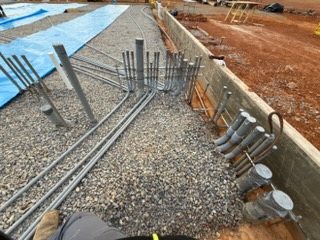
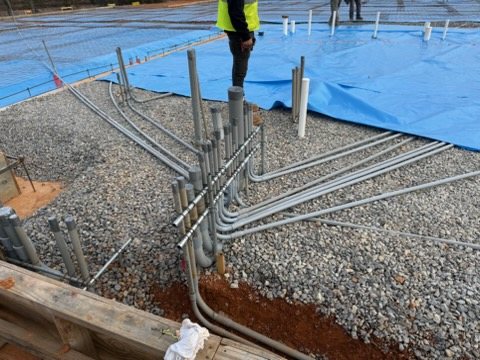
Layout is the measurement. Installation is the pipe on the wall, straight, supported, and ending in the right knockout. The two fail separately: a perfect bend in the wrong place is still wrong.
Techniques and tools
- Tape, laser, and torpedo level. A “no-dog” check keeps the two bends of an offset in one plane.
- Hand bender for smaller EMT. The shoe is stamped with the take-up, or deduct, for a 90. That number belongs to that bender, not to a chart from a different brand.
- Mechanical or electric benders for larger pipe. Hickeys show up on rigid work.
- Reamer and deburring tool. A sharp rim cuts the conductor.
- Couplings, connectors, straps, and minnies (all-thread with strut). Spacing is laid out before the first strap is anchored, or the rack walks.
- Box offset: a small kick so the connector enters the knockout while the rest of the run stays tight to the surface.
Commercial work
Above a ceiling or on a deck, the route shares space with duct, pipe, and tray. The print shows the general path. The field layout picks the elevation that stays within the bend budget and still lets someone pull the wire. Couplings are kept out of the wall. Pull boxes go where the total bend between them stays at or under 360 degrees, which is the usual raceway rule (for EMT, see the adopted Article 358).
Safety and code
- Support spacing and the distance from a box to the first support are in the raceway article. For EMT the familiar rule is within 3 feet of a box and every 10 feet, with exceptions. Confirm the edition on the job.
- Conduit fill is in NEC Chapter 9, Table 1 and the annex tables. Too many conductors makes the pull harder and can be a code violation.
- Cutting and threading throw metal. Eye protection, and a reamer, are part of the task.
- Ladders and lifts used to hang the rack follow the lift page and the employer’s fall-protection rules. MEWP safety.
What's happening now
Conduit hours track the buildings that are actually being wired right now.
- The AI buildout has hit a labor wall Data Center Dynamics, August 26, 2026
Notes that large sites need hundreds of electricians, and that some owners are moving conduit and wiring into prefabrication to cut on-site hours.
- A.I. Companies Are Recruiting Electricians and Carpenters by the Thousands The New York Times, July 29, 2026
Reports apprentices and journey workers being pulled onto data-center sites.
Code section numbers, energy-code rules, and utility practices change by edition and by city. The authority having jurisdiction, and the employer’s written program, decide what applies on a given job.