Featured interest
Advanced conduit bending
This is a professional interest. Jeffrey’s resume lists precision conduit layout and installation as a skill. The math below is study material, not a claim about a specific run he has built.
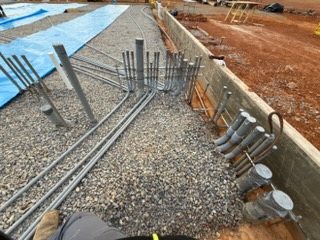
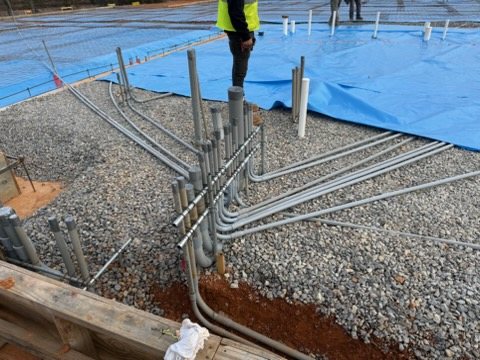
A hand bender hides a lot of the geometry in the shoe. The arrow, the star, and the deduct (take-up) are there so a 90 can be marked without a calculator. Advanced work is what happens when the pipe has to change height and direction at the same time, or when several conduits have to stay parallel through a sweep. That math is trigonometry. The multiplier electricians memorize is the cosecant of the bend angle.
Offset
An offset is two equal bends that move the conduit to a new elevation and then run straight again. If the offset height is H and each bend is angle θ, the distance between the bend marks, measured along the pipe, is:
Distance between bends = H × (1 / sin θ) = H × csc θ
Shrink = H × tan(θ / 2)
Shrink is how much shorter the run lands compared with a straight measurement between the start of the first bend and the end of the second. If the offset has to hit a fixed point, the starting mark is moved ahead by the shrink.
Field charts round the same functions. For 30 degrees, csc is exactly 2, and tan(15°) is about 0.268, which charts call 1/4 inch of shrink per inch of offset. For 45 degrees, csc is 1.414 (charts say 1.4) and tan(22.5°) is about 0.414 (charts say 3/8). For 22.5 degrees, csc is about 2.613 (charts say 2.6).
Worked example, 30 degrees
Offset height H = 6 inches. Bend angle θ = 30°.
Multiplier = 1 / sin 30° = 1 / 0.5 = 2.
Distance between bends = 6 × 2 = 12 inches.
Exact shrink = 6 × tan 15° ≈ 6 × 0.268 = 1.61 inches.
The common field chart uses 1/4 inch per inch, which is 1.5 inches for this offset. The chart is the rounded shop number. The trig is the exact one. A bender’s own gain, because the shoe has a radius, is why crews still check the finished offset with a tape.
The Master Bender manual (March 2020) works a 6-inch, 30-degree offset the chart way: 12 inches between marks and 1-1/2 inches of shrink.
Kick
A kick is a single bend, usually a small angle, used to enter a box or to hop a low obstruction. There is no second bend to bring the pipe back to parallel. The deduct stamped on the shoe still sets where a 90 starts. For a kick that is not 90, the mark is placed so the center of the bend, not the end of the pipe, produces the height you measured.
Three-point saddle
A saddle goes up over an obstruction and back down to the original line. On a symmetrical three-point saddle the center bend is twice each side bend. A usual choice is 22.5 degrees on the sides and 45 degrees in the center.
Each half is a slope of angle α over a pipe distance D, and that slope has to produce the full obstruction height H. So D = H / sin α. For α = 22.5°, sin is about 0.383, and 1 / 0.383 ≈ 2.61. The center mark sits on the center of the obstruction. Each side mark is 2.61 × H back along the pipe.
4-inch obstruction, 45° center, 22.5° sides.
Distance, center to each side mark = 4 / sin 22.5° ≈ 4 × 2.613 = 10.45 inches.
Shrink of one half = H × tan(α / 2) = 4 × tan 11.25° ≈ 4 × 0.199 = 0.80 inch.
Both halves shrink, so the run shortens by about 1.6 inches. Charts often round the 2.613 multiplier to 2.6.
Rolling offset
A rolling offset moves the pipe in two directions at once, up and to the side. The true offset is the straight-line distance through space, from the Pythagorean theorem. The bends are rolled so they sit in that tilted plane, not in a flat vertical plane.
Rise = 8 inches. Roll to the side = 6 inches. Use 30° bends.
True offset = √(8² + 6²) = √(64 + 36) = √100 = 10 inches.
Distance between bends = 10 × csc 30° = 10 × 2 = 20 inches.
Shrink ≈ 10 × tan 15° ≈ 2.68 inches.
Segmented and concentric bends
Large sweeps are made of small shots when a shoe cannot make the radius. The developed length of a bend is the arc length: radius × angle in radians. For 90 degrees that is radius × π / 2.
Inside radius = 12 inches. Conduits on 2-inch centers, so the next radius is 14 inches. Six shots of 15°.
Inside developed length = 12 × π / 2 ≈ 18.85 inches. Segment ≈ 18.85 / 6 ≈ 3.14 inches.
Outside developed length = 14 × π / 2 ≈ 21.99 inches. Segment ≈ 3.67 inches.
Using the inside spacing on the outside pipe makes the outside bend tighter, and the conduits will not stay parallel. Concentric bends keep parallel pipes parallel by giving the outer pipe a longer arc.
Code around the bend
The total bends between pull points are limited to 360 degrees in the raceway articles (EMT is Article 358 in current editions). Each offset, saddle, and kick spends part of that budget. Support rules and conduit fill still apply after the pipe is pretty. A jammed pull is often a layout problem that was ignored because the bends looked neat.
What's happening now
The demand for people who can bend and hang conduit is showing up in the same places as the rest of the electrical shortage.
- The AI buildout has hit a labor wall Data Center Dynamics, August 26, 2026
Argues that electrician headcount, not only chips and megawatts, is stalling builds, and that prefabricated conduit is one response.
- The AI data center boom is creating a dire electrician shortage. That’s an opportunity for Gen Z Fortune, March 2, 2026
Quotes contractors and researchers on how hard it is to staff the electrical portion of data-center construction.
- The Master Bender Way Precision Automated Works, manual dated March 2020
A trade manual that walks the same 30-degree offset with the field multiplier of 2 and 1/4 inch of shrink per inch of rise.
Code section numbers, energy-code rules, and utility practices change by edition and by city. The authority having jurisdiction, and the employer’s written program, decide what applies on a given job.