Safety
Electrical safety
Jeffrey’s lockout/tagout card designates him competent person on site for that training. This page explains the safety topics employers ask about. It does not add credentials that are not on the resume.
Electrical safety is a condition you create, not a mood. The references electricians actually use are OSHA’s regulations and NFPA 70E, Standard for Electrical Safety in the Workplace. The NEC builds the system. 70E is about not getting hurt while working on it. The employer’s written program is what a crew follows on Monday morning.
Shock and arc flash
Shock is current through the body. Arc flash is the explosive release when current jumps through air: heat, light, pressure, and molten metal. OSHA’s publication 4472 describes three boundaries that do not sit in a fixed stack:
- Limited approach boundary. A shock hazard exists inside it. Unqualified people cross only when a qualified person is with them.
- Restricted approach boundary. Inside this, the risk of shock is highest. Unqualified people do not cross it. Qualified people cross only with the right PPE and insulated tools.
- Arc-flash boundary. The distance at which a person without arc-rated protection could receive a second-degree burn. It can fall inside or outside the shock boundaries. NFPA 70E sets that threshold at 1.2 cal/cm². The distance itself comes from a study of that equipment, or from the 70E tables when every condition of the table is met.
PPE
Arc-rated clothing is chosen from an incident-energy analysis or from the PPE category tables. The tables are not a universal “Category 2 for 480.” They apply only when the equipment and the task match the table notes. Rubber insulating gloves with leather protectors are for shock. Arc-rated gear is for the arc. Face shields, balaclavas, and hearing protection follow the same selection. Ordinary polyester is fuel.
An electrically safe work condition
De-energized is not a guess. The sequence NFPA 70E and OSHA line up on is:
- Find every source. A backfeed from a generator, a UPS, or a control transformer counts.
- Open the disconnect. Interrupting the load first, then isolating, follows the gear’s own procedure.
- Lock and tag. See lockout/tagout. A tag alone, where a lock will fit, is not the program.
- Release stored energy. Capacitors, springs, pneumatics, gravity.
- Test before touch. Live-dead-live: prove the tester on a known source, test every conductor and the enclosure, prove the tester again. The meter’s category rating has to match the panel.
Until that sequence is done, the work is energized work. Energized work needs a justification and, where the program requires it, a permit. “It is only 277” is not a justification. OSHA’s arc-flash material treats low-voltage arcs as real injuries.
OSHA, ladders, lifts, trenches
General industry electrical rules sit in 1910 Subpart S. Construction electrical rules sit in 1926 Subpart K. Lockout for general industry is 1910.147. Construction has 1926.417 and related rules, and many contractors apply a 1910.147-style program on the site anyway. The contract and the company program say which document the crew is trained on.
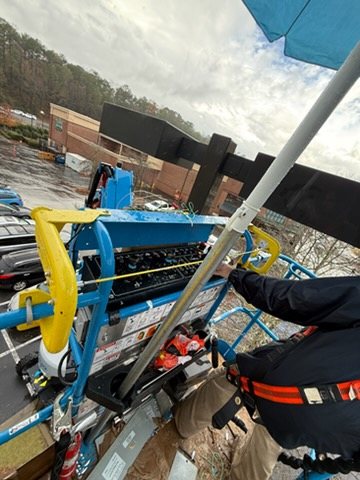
Fall protection in construction is generally triggered at 6 feet (1926.501), and in general industry at 4 feet (1910.28), with different rules for scaffolds, steel, and lifts. Three points of contact on a ladder, and a ladder that reaches the work without standing on the top cap, are the everyday version. MEWP safety covers scissor and boom lifts. Jeffrey’s resume lists operator and supervisor training for Type 3A and 3B machines.
Excavation has its own competent-person rule under 1926 Subpart P. Cave-in protection is sloping, shoring, or a shield. That designation is not the same sentence as the note on Jeffrey’s lockout card. A card for control of hazardous energy does not make someone the excavation competent person.
Job hazard analysis and the competent person
A JHA breaks the task into steps, names the hazards at each step, and writes the control: de-energize, guard, PPE, or a different method. It is done before the task, by the people who will do it.
OSHA’s construction definition of a competent person, in 1926.32(f), is someone who can identify existing and predictable hazards and who has authority to correct them. It is an employer designation for a specific subject, not a license you carry forever. Jeffrey’s lockout/tagout card, trained September 9, 2026, by Mark Leonard through M&A Electric Company, notes that he is designated competent person on site. The card covers control of hazardous energy and is valid for one year, through September 2027. That is the scope of the designation as written. It is not a claim that he is the competent person for every hazard on every site.
What's happening now
- Protecting Employees from Electric-Arc Flash Hazards OSHA Publication 4472
OSHA’s explanation of limited, restricted, and arc-flash boundaries, and why the arc-flash boundary does not have to sit inside the shock boundaries.
- NFPA 70E, Standard for Electrical Safety in the Workplace (2024) NFPA
The 2024 edition’s own description: electrically safe work conditions, lockout, PPE, and labeling.
- Control of Hazardous Energy (Lockout/Tagout) Occupational Safety and Health Administration
OSHA’s overview of 1910.147, including the training difference between authorized employees and everyone else in the area.
Code section numbers, energy-code rules, and utility practices change by edition and by city. The authority having jurisdiction, and the employer’s written program, decide what applies on a given job.